

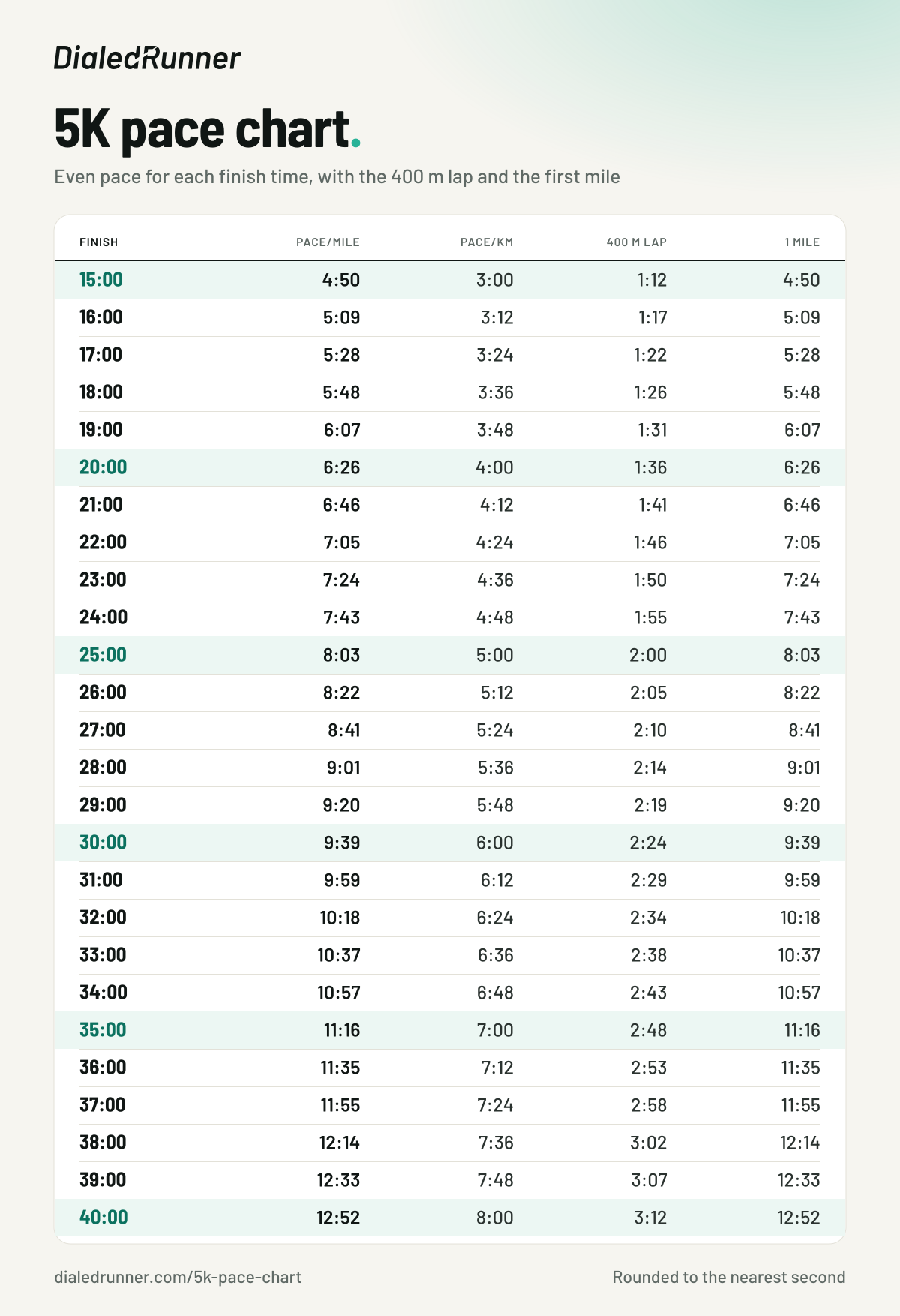
How to use the 5K pace chart
Find your goal finish time in the first column and read across: the next columns give the pace per mile and per kilometer, the speed for a treadmill, the time for one 400 m lap of a track, and the time you should see on the clock at each mile or kilometer if you run evenly. The switches above the chart change between miles and kilometers and show a row for every 10 seconds instead of every 30.
For your own goal, type the time into the 5K pace calculator. It gives the pace and a split for every mile or kilometer.
5K pace for the most popular goal times
| Finish time | Pace per mile | Pace per km | 400 m lap |
|---|---|---|---|
| 18:00 | 5:48 | 3:36 | 1:26 |
| 19:00 | 6:07 | 3:48 | 1:31 |
| 20:00 | 6:26 | 4:00 | 1:36 |
| 21:00 | 6:46 | 4:12 | 1:41 |
| 22:00 | 7:05 | 4:24 | 1:46 |
| 23:00 | 7:24 | 4:36 | 1:50 |
| 24:00 | 7:43 | 4:48 | 1:55 |
| 25:00 | 8:03 | 5:00 | 2:00 |
| 26:00 | 8:22 | 5:12 | 2:05 |
| 27:00 | 8:41 | 5:24 | 2:10 |
| 28:00 | 9:01 | 5:36 | 2:14 |
| 30:00 | 9:39 | 6:00 | 2:24 |
| 35:00 | 11:16 | 7:00 | 2:48 |
| 40:00 | 12:52 | 8:00 | 3:12 |
What is a good 5K time?
Under 29:20 is faster than the typical parkrunner, and 21:22 for men or 23:16 for women aged 30 is good by the age-grading standard runners use.
- Faster than the typical runner: under 29:20. Among 45,662 UK parkrunners who answered a survey, the middle runner had an average parkrun time of 29:20, a pace of 9:26 per mile or 5:52 per kilometer.1
- Good for your age: a 60% age grade. Age grading compares your time with the world-best time for your age and sex. USA Track & Field Masters calls 60% “local class”, 70% regional class, 80% national class and 90% world class.2
Good 5K times by age
These are the 60% age-grade times in the 2025 road-running tables:3
| Age | Men | Women |
|---|---|---|
| 30 | 21:22 (6:53 per mile) | 23:16 (7:29 per mile) |
| 40 | 22:33 (7:15 per mile) | 24:23 (7:51 per mile) |
| 50 | 24:21 (7:50 per mile) | 26:58 (8:41 per mile) |
| 60 | 26:27 (8:31 per mile) | 30:24 (9:47 per mile) |
What is the best pacing strategy for a 5K?
A brisk first kilometer, an even middle and a hard finish. Ross Tucker and colleagues analyzed every men’s world record at 5,000 m from 1922 to 2004, 32 races, kilometer by kilometer. The first and last kilometers were the fastest and the three in between were run at an even, slightly slower pace. The fast finish shows the runners kept a reserve through the middle.4
How fast should the first mile of a 5K be?
Up to 6% faster than your goal pace. In a study at the University of New Hampshire, 11 trained women ran 5 km time trials on a treadmill with the first mile set at their average race pace, 3% faster, or 6% faster. Their finishing times were not significantly different: 21:11, 20:52 and 20:39. Eight of the eleven ran their best time after the fastest start.5 It is a small study on a treadmill, but it shows that going out a few seconds per mile quick does not ruin a 5K the way it ruins a marathon.
A much faster start backfires. In four years of a state high school cross-country championship over 5 km, 3,948 performances in all, runners slowed by about 9% from the first mile to the second.6 A cross-country course is not a flat road, but that is a big drop, and it is what an over-excited start looks like.
A plan for a 25:00 goal (8:03 per mile): run the first mile in 7:50 to 8:00, hold 8:03 to 8:10 through the second, and give the third everything you have left.
5K pace for track and treadmill training
The 400 m column turns the chart into a track session planner. If your goal is 25:00, race pace is 2:00 per lap, so 800 m repeats at goal pace are 4:00 each and 1 km repeats are 5:00.
On a treadmill, use the speed column, or the treadmill pace chart to allow for incline. For how hard different sessions should feel, see the basic principles of run training.
What your 5K time predicts for longer races
Multiply your 5K time by 2.085 for a 10K and by 4.6 for a half marathon. A 25:00 5K predicts a 52:07 10K and a 1:55:00 half marathon.
Those multipliers come from Riegel’s formula, new time = old time × (new distance ÷ old distance)^1.06.7 In a study of 2,303 recreational runners it was well calibrated up to the half marathon, but too optimistic for the marathon.8 See the 10K, half marathon and marathon charts for the paces those times need.
How the 5K pace chart is calculated
Pace is finish time divided by distance, using 5,000 m for the race and 1,609.344 m for a mile, which makes a 5K 3.1069 miles. Paces and splits are rounded to the nearest second. The “3 mi” column is the time at three miles, with 0.11 miles (172 m) still to run.
Road courses are measured along the shortest possible line, with 0.1% added so they cannot come out short,9 so a GPS watch usually shows a little more than 5.00 km at the finish. Courses that are not certified can be slightly long or short. For every pace at every distance, see the general pace chart.
Footnotes
-
Haake S, Quirk H, Bullas A. parkrun and the promotion of physical activity: insights for primary care clinicians from an online survey. British Journal of General Practice. 2022;72(722):e634–e640. doi:10.3399/BJGP.2022.0001 ↩
-
USA Track & Field Masters. Age grading. 2018. usatfmasters.org/age-grading ↩
-
Jones A. Age-Grade Tables for Road Running, 2025 edition. Approved by the Masters Long Distance Running Council of USA Track & Field, January 2025. Tables and documentation ↩
-
Tucker R, Lambert MI, Noakes TD. An analysis of pacing strategies during men’s world-record performances in track athletics. International Journal of Sports Physiology and Performance. 2006;1(3):233–245. doi:10.1123/ijspp.1.3.233 ↩
-
Gosztyla AE, Edwards DG, Quinn TJ, Kenefick RW. The impact of different pacing strategies on five-kilometer running time trial performance. Journal of Strength and Conditioning Research. 2006;20(4):882–886. doi:10.1519/R-19275.1 ↩
-
Deaner RO, Lowen A. Males and females pace differently in high school cross-country races. Journal of Strength and Conditioning Research. 2016;30(11):2991–2997. doi:10.1519/JSC.0000000000001407 ↩
-
Riegel PS. Athletic records and human endurance. American Scientist. 1981;69(3):285–290. ↩
-
Vickers AJ, Vertosick EA. An empirical study of race times in recreational endurance runners. BMC Sports Science, Medicine and Rehabilitation. 2016;8:26. doi:10.1186/s13102-016-0052-y ↩
-
IAAF and AIMS. The Measurement of Road Race Courses. 2nd edition, 2004, updated 2008. PDF ↩
5K pace questions and answers
What pace is a 20-minute 5K?
6:26 per mile, or 4:00 per kilometer. On a track that is 1:36 per 400 m lap; on a treadmill it is 9.3 mph or 15.0 km/h.
What pace is a sub-20-minute 5K?
6:26 per mile or faster, which finishes in 19:59, or 3:59 per kilometer or faster. Exactly 4:00 per kilometer is 20:00 on the dot. On a track it is 1:35 per 400 m lap.
What pace is a 25-minute 5K?
8:03 per mile, or 5:00 per kilometer, which is 2:00 per 400 m lap. On a treadmill that is 7.5 mph or 12.0 km/h.
What pace is a 30-minute 5K?
9:39 per mile, or 6:00 per kilometer, which is 2:24 per 400 m lap. On a treadmill that is 6.2 mph or 10.0 km/h.
What pace is a 40-minute 5K?
12:52 per mile, or 8:00 per kilometer, which is 4.7 mph or 7.5 km/h. That is a steady jog, or a run-walk mix.
How should I pace a 5K?
Start at goal pace or a little faster, settle by the end of the first kilometer, hold on through the third and fourth, and finish hard. A small study found that a first mile 3% to 6% faster than average pace did not hurt the final time, so a brisk start is fine in a 5K. A reckless one is not: young runners in one large study slowed by about 9% from the first mile to the second.
What is a good pace for a 5K?
Faster than 9:26 per mile (5:52 per km) beats the typical runner: the middle runner among 45,662 UK parkrunners in a survey averaged 29:20. A good pace by the age-grading tables (60%, local class) is 6:53 per mile for a man aged 30 and 7:29 per mile for a woman aged 30, a 21:22 and a 23:16 5K.
What is a good 5K time by age?
By the age-grading tables runners use, a good 5K (a 60% age grade, which USATF Masters calls local class) is 21:22 for men and 23:16 for women aged 30, 22:33 and 24:23 at 40, 24:21 and 26:58 at 50, and 26:27 and 30:24 at 60.
How many miles is a 5K?
5 kilometers is 3.1069 miles, or 12.5 laps of a standard 400 m track.


