

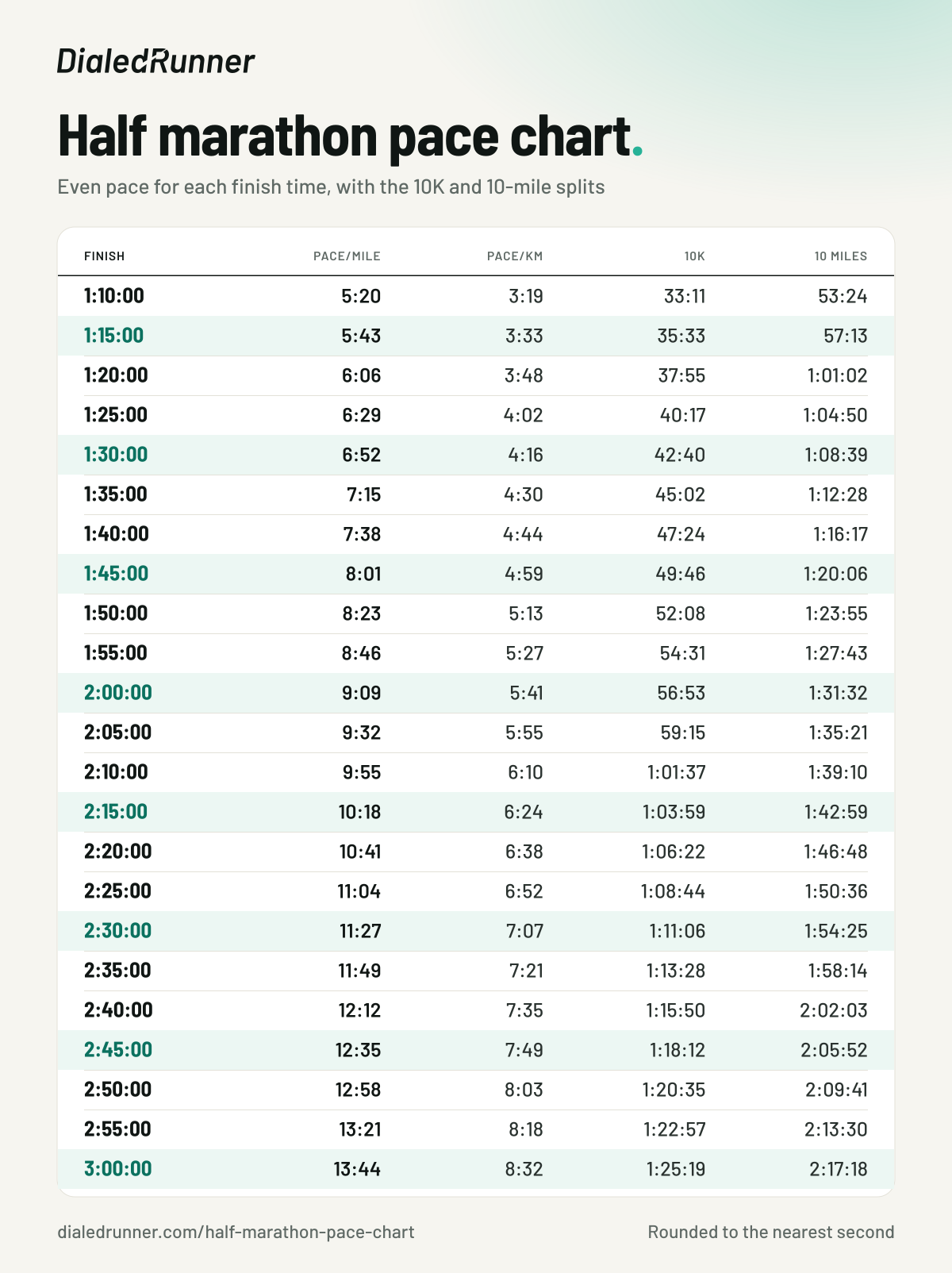
How to use the half marathon pace chart
Find your goal finish time in the first column and read across: the next columns give the pace per mile and per kilometer, the speed for a treadmill, and the time you should see on the clock at points along the course if you run evenly. The switches above the chart change between miles and kilometers and show a row for every minute instead of every five.
For your own goal, type the time into the half marathon pace calculator. It gives the pace, a split for every mile or kilometer, and a pace band you can print and tape round your wrist.
Half marathon pace for the most popular goal times
| Finish time | Pace per mile | Pace per km | 10K split |
|---|---|---|---|
| 1:30 | 6:52 | 4:16 | 42:40 |
| 1:40 | 7:38 | 4:44 | 47:24 |
| 1:45 | 8:01 | 4:59 | 49:46 |
| 1:50 | 8:23 | 5:13 | 52:08 |
| 2:00 | 9:09 | 5:41 | 56:53 |
| 2:10 | 9:55 | 6:10 | 1:01:37 |
| 2:15 | 10:18 | 6:24 | 1:03:59 |
| 2:30 | 11:27 | 7:07 | 1:11:06 |
| 3:00 | 13:44 | 8:32 | 1:25:19 |
What is a good half marathon time?
1:35:52 for men and 1:45:00 for women aged 30. Those are 60% age-grade times. Age grading compares your time with the world-best time for your age and sex. USA Track & Field Masters calls 60% “local class”, 70% regional class, 80% national class and 90% world class.1 By the 2025 road-running tables,2 the 60% half marathon times are:
| Age | Men | Women |
|---|---|---|
| 30 | 1:35:52 (7:19 per mile) | 1:45:00 (8:01 per mile) |
| 40 | 1:39:28 (7:35 per mile) | 1:49:08 (8:19 per mile) |
| 50 | 1:48:12 (8:15 per mile) | 1:59:42 (9:08 per mile) |
| 60 | 1:58:37 (9:03 per mile) | 2:15:45 (10:21 per mile) |
How to pace a half marathon
Run it at an even pace, and hold that pace through the middle of the race. Reviews of pacing research find that for any race longer than a couple of minutes, performance is best when effort is spread evenly,3 and the half marathon shows it clearly.
Brian Hanley analyzed the splits of 838 runners across six IAAF World Half Marathon Championships. The best men and women largely kept their speed between 5 km and 15 km. Slower finishers were already losing speed from 5 km onward. Runners who stayed in a pack for the whole race slowed less than those who ran alone or lost their group early.4
Two things follow for the rest of us. First, the race is decided in the middle: if you are still on pace at 15 km, you have run it well. Second, company helps. Find people running your pace, or a pacer if the race provides them, and stay with them.
Should you run a negative split in a half marathon?
Plan a small one: the second half 1% faster than the first. For a 2:00 goal that is a first half of 1:00:18 and a second of 59:42. The reason is the risk, not a proven gain. Race results at every distance studied show that slowing is common and speeding up is rare. Reaching halfway a few seconds behind schedule costs almost nothing; reaching it a minute ahead often costs several minutes by the end. No study has yet shown recreational runners finishing a half marathon faster with a negative split than with an even one.
How to predict your half marathon time
Multiply your 10K time by 2.21, or your 5K time by 4.6. A 50:00 10K predicts 1:50:19, and a 25:00 5K predicts 1:55:00.
Both multipliers come from Riegel’s formula: new time = old time × (new distance ÷ old distance)^1.06.5 Unlike the marathon prediction, this one holds up for ordinary runners. In a study of 2,303 recreational runners, the formula was well calibrated for races up to the half marathon and only went wrong at the full marathon, where it was far too optimistic.6 Use the 10K or 5K chart to find the pace you have already run, then pick your half marathon row.
Why does my watch show more than 13.1 miles?
Because a certified course is measured along the shortest route a runner could possibly take, and 0.1% is then added so that it cannot come out short.7 You will not run that perfect line, so you cover slightly more than 21.0975 km, and your watch adds its own error. In a field study at a half marathon, GPS sport watches were off by an average of 0.12 km, about 0.6%, and phones by 0.35 km.8
At 2:00 pace, 0.6% is 43 seconds. To avoid being surprised by it:
- Go by the course markers. Press the lap button at each marker and compare the time with your pace band.
- Leave a margin. Set the GPS watch margin in the pace calculator and it tells you the pace to hold on the watch.
- Let the watch do the sums. Garmin’s PacePro gives a target for every split and shows how far ahead or behind you are. I cover it in racing with a Garmin watch.
How the half marathon pace chart is calculated
Pace is finish time divided by distance, using 21.0975 km for the half marathon and 1,609.344 m for a mile, which makes the race 13.1094 miles. Paces and splits are rounded to the nearest second.
For other distances see the marathon, 10K and 5K charts, the general pace chart, or the treadmill pace chart for converting these paces to a belt speed.
Footnotes
-
USA Track & Field Masters. Age grading. 2018. usatfmasters.org/age-grading ↩
-
Jones A. Age-Grade Tables for Road Running, 2025 edition. Approved by the Masters Long Distance Running Council of USA Track & Field, January 2025. Tables and documentation ↩
-
Abbiss CR, Laursen PB. Describing and understanding pacing strategies during athletic competition. Sports Medicine. 2008;38(3):239–252. doi:10.2165/00007256-200838030-00004 ↩
-
Hanley B. Pacing profiles and pack running at the IAAF World Half Marathon Championships. Journal of Sports Sciences. 2015;33(11):1189–1195. doi:10.1080/02640414.2014.988742 ↩
-
Riegel PS. Athletic records and human endurance. American Scientist. 1981;69(3):285–290. ↩
-
Vickers AJ, Vertosick EA. An empirical study of race times in recreational endurance runners. BMC Sports Science, Medicine and Rehabilitation. 2016;8:26. doi:10.1186/s13102-016-0052-y ↩
-
IAAF and AIMS. The Measurement of Road Race Courses. 2nd edition, 2004, updated 2008. PDF ↩
-
Pobiruchin M, Suleder J, Zowalla R, Wiesner M. Accuracy and adoption of wearable technology used by active citizens: a marathon event field study. JMIR mHealth and uHealth. 2017;5(2):e24. doi:10.2196/mhealth.6395 ↩
Half marathon pace questions and answers
What pace is a 2-hour half marathon?
9:09 per mile, or 5:41 per kilometer, passing 10K in 56:53 and 10 miles in 1:31:32. To finish under two hours you need to average slightly faster, so aim for about 9:05 per mile or 5:39 per kilometer.
What pace is a 1:45 half marathon?
8:01 per mile, or 4:59 per kilometer. That is 7.5 mph or 12.1 km/h.
What pace is a sub-2-hour half marathon?
Faster than 9:09 per mile, or 5:41 per kilometer. To leave a margin, aim for 9:00 per mile (5:36 per km), which finishes in 1:57:59.
What pace is a 1:50 half marathon?
8:23 per mile, or 5:13 per kilometer. That is 7.2 mph or 11.5 km/h.
What pace is a 1:30 half marathon?
6:52 per mile, or 4:16 per kilometer. That is 8.7 mph or 14.1 km/h.
What pace is a 2:30 half marathon?
11:27 per mile, or 7:07 per kilometer. A 2:15 half marathon is 10:18 per mile, or 6:24 per kilometer.
What pace is a 3-hour half marathon?
13:44 per mile, or 8:32 per kilometer. That is 4.4 mph or 7.0 km/h, a mix of brisk walking and easy running. Check the time limit for your race before you plan around it.
What is a good half marathon time?
1:36 for a man and 1:45 for a woman aged 30, by the age-grading tables runners use (a 60% age grade, which USATF Masters calls local class). At 50 it is 1:48 for men and 2:00 for women.
How should I pace a half marathon?
At an even pace. Start at your goal pace or a few seconds per mile slower, hold it through 10 miles (16 km), and use whatever you have left over the last 5 km. At the world championships, the best finishers were the ones who kept their speed between 5 km and 15 km while everyone else slowed.
How long is a half marathon in miles and kilometers?
21.0975 kilometers, which is 13.1094 miles. The chart uses the exact figure, not 13.1.


