

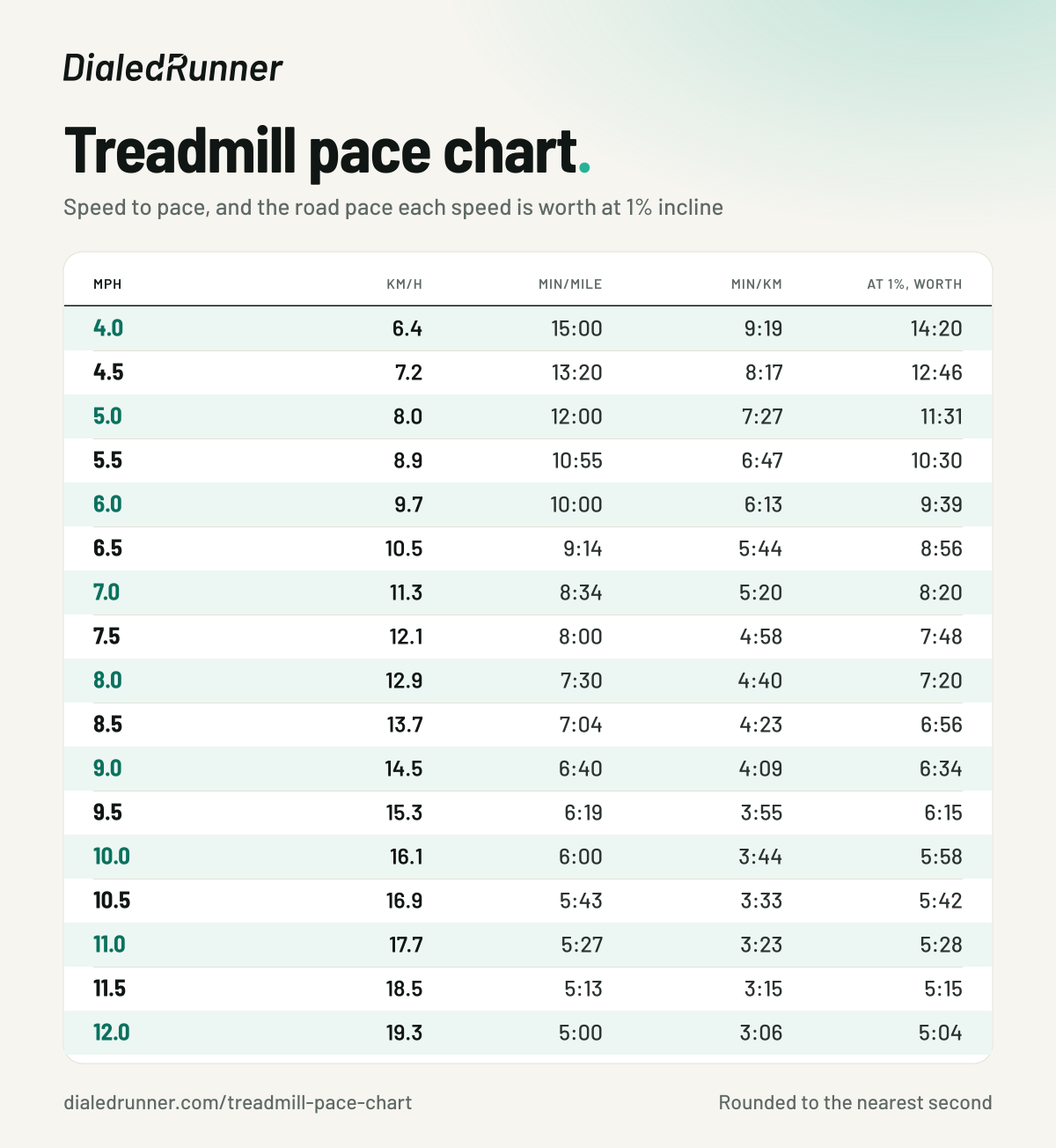
How to convert treadmill speed to pace
Divide 60 by the speed. A treadmill shows speed (distance per hour), runners think in pace (time per distance), and one is the other turned upside down:
- Pace per mile = 60 ÷ speed in mph. At 7.5 mph, 60 ÷ 7.5 = 8, so 8:00 per mile.
- Pace per kilometer = 60 ÷ speed in km/h. At 12 km/h, 60 ÷ 12 = 5, so 5:00 per kilometer.
- mph to km/h: multiply by 1.609. km/h to mph: divide by 1.609.
Treadmill speed for the most common paces
| Pace per mile | Treadmill speed | Pace per km |
|---|---|---|
| 12:00 | 5.0 mph (8.0 km/h) | 7:27 |
| 11:00 | 5.5 mph (8.8 km/h) | 6:50 |
| 10:00 | 6.0 mph (9.7 km/h) | 6:13 |
| 9:00 | 6.7 mph (10.7 km/h) | 5:36 |
| 8:00 | 7.5 mph (12.1 km/h) | 4:58 |
| 7:00 | 8.6 mph (13.8 km/h) | 4:21 |
| 6:00 | 10.0 mph (16.1 km/h) | 3:44 |
Use the general pace chart if you want to start from a pace instead of a speed, or one of the race charts (5K, 10K, half marathon, marathon) to start from a finish time.
Is treadmill running easier than running outside?
Yes, slightly: at the same speed a treadmill takes less energy, because you do not push through any air. The gap grows with speed.
Griffith Pugh measured it in 1970 by putting runners on a treadmill in front of a wind: the extra oxygen they needed rose with the square of the wind speed, and he estimated that air resistance accounts for about 8% of the energy cost of running on a track at 21.5 km/h (a 4:29 mile).1 At slower speeds the share is smaller. A later wind-tunnel study put it lower still, at about 2% at marathon race speed and 4% at middle-distance speed.2 This page uses Pugh’s figure; what the lower one would change is explained under the incline calculation below.
Everything else about treadmill running is close to the real thing. A 2020 review pooled 33 studies with 494 runners and found that stride timing, joint angles, forces and muscle activity were largely comparable between a motorized treadmill and the ground, with some differences in how the foot lands.3 A companion review of 34 studies found that oxygen use at ordinary training speeds was similar on a treadmill and on the ground. It also found that runners did worse in endurance tests on a treadmill, and that heart rate and perceived effort ran higher on the treadmill at faster speeds and lower at slower ones.4 So a treadmill is physically a little easier at a given speed, but it does not always feel that way. One plausible reason is heat: indoors there is no breeze to cool you.
Should you set the treadmill to 1% incline?
Only for fast running. At easy paces 1% is more than you need, and at 6 mph a flat belt is already within ten seconds per mile of the road.
The advice comes from a study by Andrew Jones and Jonathan Doust in 1996. Nine trained runners ran at six speeds between 2.92 and 5.0 meters per second (9:11 to 5:22 per mile) on a treadmill at 0%, 1%, 2% and 3%, and on a level road, while their oxygen use was measured. The 1% grade matched the road best overall.5
The detail is often left out. At the two slowest speeds (9:11 and 8:03 per mile), the road was not measurably different from a flat treadmill or from 1%. Only from about 7:09 per mile did the flat treadmill fall clearly short. That fits the physics: air resistance grows quickly with speed, so slow runners lose almost nothing by leaving the belt flat. The 2019 review agrees, finding oxygen use similar to overground running at both 0% and 1%.4
The incline that cancels the missing air resistance at each speed, from the measurements this page uses:
| Treadmill speed | Pace | Incline that matches the road |
|---|---|---|
| 6.0 mph (9.7 km/h) | 10:00 per mile | 0.3% |
| 7.0 mph (11.3 km/h) | 8:34 per mile | 0.4% |
| 8.0 mph (12.9 km/h) | 7:30 per mile | 0.6% |
| 9.0 mph (14.5 km/h) | 6:40 per mile | 0.7% |
| 10.0 mph (16.1 km/h) | 6:00 per mile | 0.9% |
| 12.0 mph (19.3 km/h) | 5:00 per mile | 1.3% |
In practice: use 1% for steady and fast running, 0.5% for easy runs, and leave the belt flat for a recovery jog.
How the treadmill incline chart is calculated
The incline chart and the “worth outdoors” figure in the treadmill pace calculator answer one question: what pace on a flat road, in still air, uses energy at the same rate as this belt speed and incline? Two published measurements go into it.
- The cost of running uphill. Alberto Minetti and colleagues measured the energy cost of running on a treadmill at slopes from −45% to +45% and fitted a curve to it.6 By that curve a 1% incline costs about 5.5% more energy per meter than level running, 2% about 11% more, 5% about 30% more and 10% about 66% more.
- The cost of air resistance outdoors. Pugh’s figure of 8% of total energy cost at 21.5 km/h, scaled with the square of speed as he measured.1
The treadmill side of the sum is belt speed × the uphill cost. The outdoor side is road speed × (1 + the air cost at that speed). The chart shows the road speed at which the two are equal.
What it assumes:
- It uses the higher air-resistance figure. If the lower one is right,2 the true outdoor equivalents are 1% to 3% faster than shown, which is about six seconds per mile at easy paces and ten at fast ones. The real answer lands between the belt pace and the chart.
- It is for running, not walking. Walking uphill follows a different cost curve, so the incline chart starts at 5 mph.
- It assumes you run freely. Holding the handrails takes weight off your legs and makes any incline easier than its number.
- It assumes the treadmill is honest. Belt speed and incline are only as accurate as the machine’s last calibration.
- Outdoors is rarely flat or still. A headwind, a hill or a pack of runners to shelter behind all change the real cost. Pugh found that running one meter behind another runner removed most of the air resistance.7
Why does my watch show a different pace from the treadmill?
Because indoors your watch is guessing. It has no GPS signal to measure distance with, so it estimates your speed from the swing of your arm, and that estimate can be well off, particularly at paces you rarely run outdoors.
On a Garmin, choose the Treadmill activity rather than Run so the watch does not hunt for satellites, and when you finish, pick Calibrate & Save and enter the distance the treadmill shows. The watch uses that to correct its indoor estimate for next time. Garmin asks for a run of a mile or two before the option appears. If you are still setting the watch up, start with how to set up your Garmin watch for running.
When the two numbers differ, trust the treadmill: its speed comes from the belt, not from your arm.
Footnotes
-
Pugh LGCE. Oxygen intake in track and treadmill running with observations on the effect of air resistance. The Journal of Physiology. 1970;207(3):823–835. doi:10.1113/jphysiol.1970.sp009097 ↩ ↩2
-
Davies CTM. Effects of wind assistance and resistance on the forward motion of a runner. Journal of Applied Physiology. 1980;48(4):702–709. doi:10.1152/jappl.1980.48.4.702 ↩ ↩2
-
Van Hooren B, Fuller JT, Buckley JD, et al. Is motorized treadmill running biomechanically comparable to overground running? A systematic review and meta-analysis of cross-over studies. Sports Medicine. 2020;50(4):785–813. doi:10.1007/s40279-019-01237-z ↩
-
Miller JR, Van Hooren B, Bishop C, Buckley JD, Willy RW, Fuller JT. A systematic review and meta-analysis of crossover studies comparing physiological, perceptual and performance measures between treadmill and overground running. Sports Medicine. 2019;49(5):763–782. doi:10.1007/s40279-019-01087-9 ↩ ↩2
-
Jones AM, Doust JH. A 1% treadmill grade most accurately reflects the energetic cost of outdoor running. Journal of Sports Sciences. 1996;14(4):321–327. doi:10.1080/02640419608727717 ↩
-
Minetti AE, Moia C, Roi GS, Susta D, Ferretti G. Energy cost of walking and running at extreme uphill and downhill slopes. Journal of Applied Physiology. 2002;93(3):1039–1046. doi:10.1152/japplphysiol.01177.2001 ↩
-
Pugh LGCE. The influence of wind resistance in running and walking and the mechanical efficiency of work against horizontal or vertical forces. The Journal of Physiology. 1971;213(2):255–276. doi:10.1113/jphysiol.1971.sp009381 ↩
Treadmill pace questions and answers
What speed on a treadmill is a 10-minute mile?
6.0 mph, which is 9.7 km/h. A 9-minute mile is 6.7 mph (10.7 km/h), an 8-minute mile is 7.5 mph (12.1 km/h), a 7-minute mile is 8.6 mph (13.8 km/h) and a 6-minute mile is 10.0 mph (16.1 km/h).
What speed on a treadmill is a 9-minute mile?
6.7 mph, which is 10.7 km/h. Exactly 9:00 per mile is 6.67 mph, so 6.7 on the display is an 8:57 mile.
What speed on a treadmill is an 8-minute mile?
7.5 mph, which is 12.1 km/h. An 8-minute mile is 4:58 per kilometer.
How fast is 7.0 on a treadmill?
If the treadmill shows miles per hour, 7.0 is a pace of 8:34 per mile, or 5:20 per kilometer. If it shows kilometers per hour, 7.0 is 8:34 per kilometer, a brisk walk. Check which unit your machine uses before you compare numbers with someone else.
What mile pace is 8 mph on a treadmill?
7:30 per mile, or 4:40 per kilometer. Held for a whole race, that is a 23:18 5K or a 3:16:38 marathon.
What pace is 6.5 on a treadmill?
6.5 mph is 9:14 per mile, or 5:44 per kilometer. Held for a whole race, that is a 28:41 5K or a 4:02:01 marathon.
What do 7.4 mph and 7.8 mph mean on a treadmill?
7.4 mph is 8:06 per mile (5:02 per km) and 7.8 mph is 7:42 per mile (4:47 per km). The number is your speed; divide 60 by it to get minutes per mile.
Should I set the treadmill to 1% incline?
Only for fast running. The incline that makes up for the missing air resistance is 0.3% at 6 mph, 0.6% at 8 mph, 0.9% at 10 mph and 1.3% at 12 mph, so 1% matches the road at paces around 6:00 per mile and faster. At 6 mph a flat belt is worth 10:10 per mile on the road, ten seconds off what the display says. The 1% rule comes from a 1996 study of trained runners.
What does 12% incline mean on a treadmill?
The belt rises 12 units for every 100 units along it, a slope of about 6.8 degrees. It is the setting in the 12-3-30 walking workout: 12% incline at 3 mph for 30 minutes.
Is running on a treadmill easier than running outside?
Yes, slightly. At the same speed it costs less energy, because you are not pushing through the air, and the gap grows with speed. A pooled analysis of 34 studies found oxygen use at ordinary training speeds was similar on a treadmill at 0% or 1% and on the ground. The same analysis found that people lasted less long in endurance tests on a treadmill, so easier on paper does not always mean easier in practice.
How do I convert km/h to minutes per kilometer?
Divide 60 by the speed. 10 km/h is 6:00 per km, 12 km/h is 5:00 per km and 15 km/h is 4:00 per km. For minutes per mile from mph it is the same sum: 60 divided by 7.5 mph is 8:00 per mile.


